LevelLoop wrote this play brief. The playable file, artwork, and runtime are delivered by an external game service. LevelLoop keeps supporting rights records for the catalog on file.
ShelfPuzzle
Eight columns, five rows
A drag trades two tiles at once
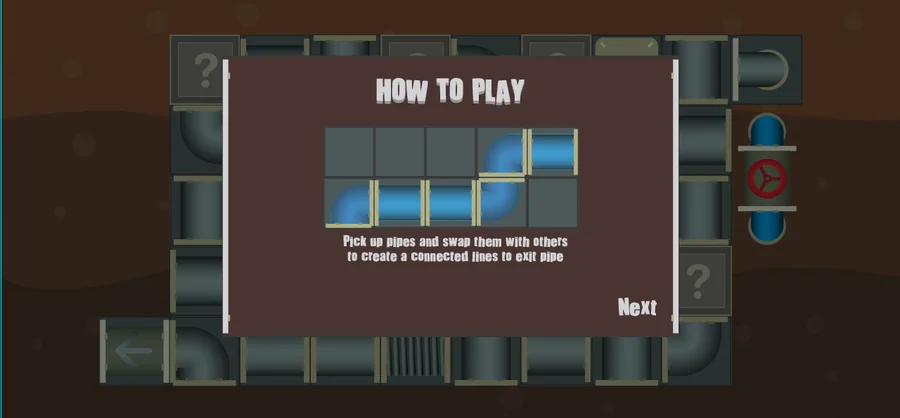
The board is 8 columns by 5 rows - 40 tiles of 100 pixels each - and the game states its own rule on the first HOW TO PLAY card: Pick up pipes and swap them with others to create a connected lines to exit pipe. Nothing rotates. When you release a tile, the build looks for a tile whose centre is within 50 pixels of the drop point; if it finds one it exchanges the two entries on the board and both pipes move at once. If it finds nothing, the tile snaps back to the slot it came from.
Observed 2026-10-04 in Chrome: the board opens behind a HOW TO PLAY card that states the rule in one line, and two tiles on the grid already carry a question mark while a green arrow tile marks the water's entry.
Some tiles you simply cannot lift
The pick-up handler refuses a tile whose type is block, and it refuses a tile the water has already reached, because it tests the fill amount against zero before starting a drag. The same test runs on the tile you are dropping onto, and a tile that is still hidden underneath cannot be a target either. The movable part of the board therefore shrinks as the water spreads, so arrange the route early and use the dry half of the grid later.
Five tile types
Water, slowdowns, hidden tiles and blocks
The second card names the whole cast: Empty piece, Occupied piece, Slowdown piece, Hidden piece and Block piece, and adds a Full water release button beside them. A stage opens with 3 blocks, 3 slowdown tiles and a hidden share of 10 per cent - four hidden tiles out of the 40 on a fresh board - and the hidden ones can be clicked away to reveal the pipe underneath.
The layout is shuffled, not random
The entrance and the exit sit on opposite edges at rows drawn at random for each stage, and the build then lays a route between them with an A* search that is not allowed to move diagonally. That route decides which pipes are straight and which are corners. Afterwards the route tiles are swapped to random non-block positions, which is why a fresh stage looks scrambled but is still solvable with the tiles you were given.
A stage is finished when the water actually reaches the exit. A slowdown tile costs you time, not points: the water tween runs 1.5 times slower across it, which is the one square type that changes the clock you are racing.
Speed 10, more blocks
The water gets faster every two stages
Water speed starts at 10 and rises by 1 for every 2 completed stages. Blocks start at 3 and rise by 2 every 3 stages. The hidden share starts at 10 per cent and rises by a further 10 per cent after every single stage, which is the fastest-moving of the three. The results panel is headed Best Score: and its score line prints STAGE plus the number you reached.
One swap, then watch
Because each swap moves two tiles, a careless trade can open one joint while closing another. Make one exchange, watch the water cross the stretch you changed, and only then pick the next pair. The water release button lets you send it down the line early, which is the cheapest way to find out whether the route is really connected.
Plumber Pipe FAQ
Swapping, dropping and blocked tiles
These answers stay with what the board itself enforces: two tiles per move, a 50-pixel drop window, and three square types that will not move once the water is through.
Why do I swap pipes instead of rotating them?
Because the game never turns a tile. The HOW TO PLAY card says to pick up pipes and swap them with others, and the code does exactly that: dropping a tile on another tile exchanges the two board positions. Every move therefore changes two slots at once, so read both ends before you lift anything.
What should I check before the first swap?
Look at what is still free. You cannot pick up a block tile, and you cannot pick up a tile the water has already reached, so the movable set shrinks as the stage runs. On stage 1 that leaves 3 blocks, 3 slowdown tiles and 4 hidden tiles out of 40.
How close do I have to drop a tile?
Within 50 pixels of the other tile's centre, which is half a tile. Aim at the middle of the target rather than at its edge: a drop that misses every centre by more than 25 pixels simply snaps back to where it started.
How long is a run?
There is no clock. The water starts moving at speed 10 and the results panel is headed Best Score: with STAGE plus the number you reached, so the stage count is the score and the run ends when the water stops reaching the exit.