LevelLoop wrote this play brief. The playable file, artwork, and runtime are delivered by an external game service. LevelLoop keeps supporting rights records for the catalog on file.
ShelfArcade
Board and controls
Tap a jelly and every joined jelly of that colour goes with it
The playfield is an 8 by 8 grid, and the build carries 5 pudding colours: red, blue, yellow, green and purple. A tap does not take one piece. The build walks the four neighbours of whatever you tapped and keeps walking while the piece matches the one you started on, so one tap takes the tapped jelly plus every jelly of that colour joined to it up, down, left and right. That connected group is the whole mechanic; there is no larger pudding to build and no second tier to reach.
The move only counts when the tap actually takes something. A group has to be at least 2 pieces, and a lone jelly answers with a refusal sound and a shake instead of a move lost. That is what makes an early round cheap to read: you can tap around a level for free until you find a colour that is genuinely joined up.
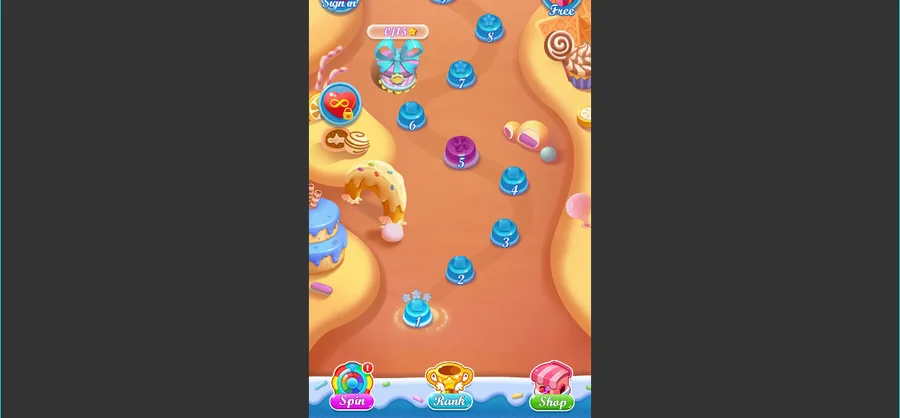
Observed 2026-10-04 in Chrome at 1280×800: the map screen shows numbered jelly nodes starting at 1, a chest bar reading 0/15 with a star icon, 100 in the gem pill and 0 in the star pill.
A move budget, not a clock
Levels are counted in moves. Level 1 is set to 25 moves, level 2 to 20, and the step budgets across the build's 300 level entries run from 18 up to 95. A level is played out against that counter rather than a countdown, which is why a wasted move costs more than a slow one.
If you stall, the build notices. After 3 seconds without input it highlights a group that can still be taken, but only while more than 5 moves remain, so the hint disappears exactly when the run gets tight.
What the level asks
Targets on the board and score tiers above them
Each level names the puddings it wants cleared. Level 1 asks for 12 blue puddings and 8 red puddings, and its board only deals 4 of the 5 colours, so two colours are the whole job. The target list is a countdown, not a bonus: the level is complete when those counts reach zero.
What a group is worth
Score is computed from the size of the group you take. The build's own formula is (2 + n) times (n - 1) times 5, which pays 20 points for 2 pieces, 50 for 3, 90 for 4 and 140 for 5. A long run of one colour is worth far more per move than the same pieces taken two at a time.
Level 1 also carries four score thresholds at 1,500, 3,000, 7,500 and 20,000. The first three map to the stars on the level node; the fourth sits above them, so clearing the targets and reaching the highest tier are two different jobs. The build's level table holds 300 entries.
Outside a level
Star chests, unlock gates and the sign-in table
Stars collected across levels feed a chest track on the map. The five gates are 15, 50, 100, 180 and 250 stars, paying 100, 200, 300, 400 and 500 diamonds in that order. The map screen shows the first of them as a bar reading 0/15 next to a star icon, which is the same gate the build's chest table opens with.
Three items, three gates
Three board items are locked behind the level counter rather than a shop: one at level 4 for 80 coins, one at level 8 for 150, and one at level 24 for 250. The on-screen buttons follow the same idea: Sign in unlocks at level 3, Rank at level 5, and both the daily gift and the week-game tab wait until level 10.
The sign-in panel observed on load was titled Daily logon and ran a seven-day grid: Day1 paid 100, Day2 3, Day3 2, Day4 200, Day5 3, Day6 3, and the seventh tile paid 500 with 3 and 1 beside it. The build's own sign-in table lists exactly those seven payouts, so the panel and the code agree.
Energy is the other limiter: the build caps it at 5 and refills one unit on a 1,800-second recovery setting. When a run ends with moves still owed, the lose screen offers 5 more moves for a video, and a set of three spins counts as one lucky-wheel batch.
Jelly Boom questions
The 8 by 8 board, the 25 moves and the star chests
These answers stay with what the map screen showed and with the numbers the game's own script carries: the connected-colour tap, the per-level move budget, and the gates that open outside a level.
What actually happens when I tap a jelly in Jelly Boom?
You take the tapped jelly plus every jelly of the same colour joined to it up, down, left and right. The board is 8 by 8 and the build walks the four neighbours of the tapped piece, so the group can be as small as 2 pieces or as long as the joining allows.
How many moves does a level give me?
It is set per level. Level 1 carries 25 moves, level 2 carries 20, and the step budgets across the build's 300 level entries run from 18 up to 95. The level is played against that counter rather than a clock.
What are the levels asking me to clear?
A counted list of puddings. Level 1 wants 12 blue and 8 red puddings, and its board deals only 4 of the 5 colours. The target counter reaching zero is the win, and the score tiers above it only decide how many stars the node gets.
How is the score calculated?
From the size of the group you take: (2 + n) times (n - 1) times 5, which is 20 points for 2 pieces, 50 for 3, 90 for 4 and 140 for 5. Taking one long colour run beats taking the same pieces two at a time.
What are the star chests on the map?
Five gates at 15, 50, 100, 180 and 250 stars, paying 100, 200, 300, 400 and 500 diamonds. The map shows the first as a bar reading 0/15, which is the opening gate in the build's chest table.