A ball-painting game built on a mesh of small spheres: you throw a coloured ball at one of them and its whole colour group flips, and the wave ends when all 1,656 spheres share a colour.
LevelLoop wrote this play brief. The playable file, artwork, and runtime are delivered by an external game service. LevelLoop keeps supporting rights records for the catalog on file.
ShelfPuzzle
The captured frame
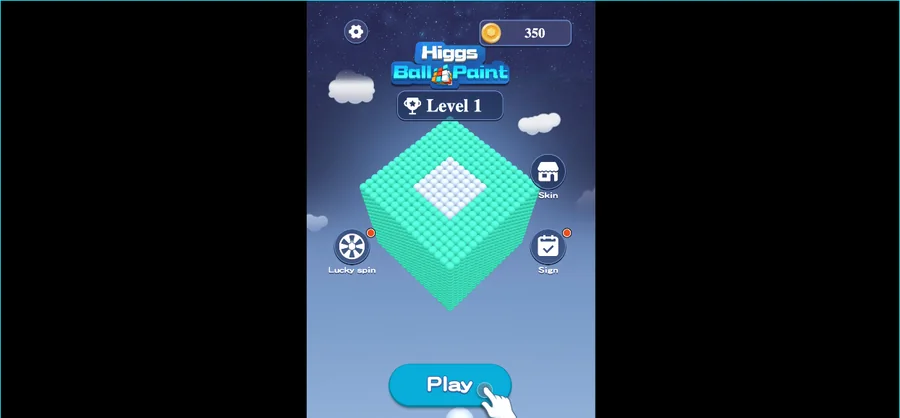
Level 1, a coin counter reading 350, and a cube made of small spheres
The captured frames of the main screen carry the title Higgs Ball Paint with a small paint-bucket character, a Level 1 badge beside it, a coin counter reading 350 in the top corner, and three round buttons labelled Lucky spin, Skin and Sign around a blue Play button. The object in the middle is the game: an isometric cube assembled from many small teal spheres with a white diamond left on its top face.
Observed 2026-10-04 in Chrome at 1280×800: the main screen shows Higgs Ball Paint with a Level 1 badge, a coin counter reading 350, the sphere cube in the middle, and the Lucky spin, Skin and Sign buttons around the blue Play button.
How many spheres the board actually holds
The mesh is not decoration. The build reads the number of spheres straight out of the mesh it loads, and its default board holds 1,656 of them, with 1,485 loaded at start-up. There are 9 mesh shapes available, drawn at three different scales, and every rule in the game, from the progress bar to the win, is counted in spheres out of that total.
The first captured frame shows the counter at 300 with a Gift dialog offering 50 coins and an Obtain button, and the next capture shows the same screen at 350, which is the same 50 coins collected.
One throw
Tap a sphere and its colour group flips with it
A run throws balls, not swipes. Tapping a sphere casts a ray into the cube, the ball you are holding is sent along a curved path to that sphere at a speed of 10, and when it lands the sphere takes your ball's colour. The spheres connected to it that shared its old colour flip as well, so a well chosen target repaints a whole region instead of a single sphere.
When a wave is over
The wave ends when the mesh is one colour: the game counts how many spheres share each colour and compares the largest group against the full 1,656. The progress bar on screen is that largest group over the total, and once it passes 70 percent the next ball handed to you is the colour the board still needs rather than a random one. A wave scores 3 points per repainted sphere, and 5 points each when a single throw repaints more than 100.
Twenty balls a run
Three waves, then the level pays 1,000 a ball
Every run is handed 20 balls and every throw spends one, whether it repaints anything or not. The level itself is 3 waves long: clear a wave and the same mesh is repainted with fresh colours for the next one, and clearing the third ends the level. A run that spends all 20 balls before the mesh is one colour is over.
What the win pays
The win panel is paid on the balls you did not throw: 1,000 points each, on top of the points already scored, plus 50 coins and one more coin per spare ball. That makes an early finish worth far more than a run that grinds the last few spheres with the last few balls. Every fifth level swaps in a boss stage, and the build carries 9 mesh shapes to draw from.
Pre-run check
Spheres, balls and the win panel
These answers stay with the main screen that was captured and with the numbers the build counts in. The one habit worth forming first is to aim at a colour group rather than the nearest sphere, because one throw can flip a whole region.
How does one throw work?
Tap a sphere in the cube and the ball you are holding is sent to it at a speed of 10. The sphere takes the ball's colour, and the connected spheres that shared its old colour flip with it.
How do I know a wave is finished?
When every sphere on the mesh is the same colour. The game counts the largest colour group and compares it against all 1,656 spheres, and the progress bar on screen is that same fraction.
How many balls do I get?
20 per run, and every throw spends one whether it repaints anything or not. A run ends when the balls are gone before the mesh has turned one colour.
What does winning a level pay?
1,000 points for every ball you did not throw, plus 50 coins and one more coin per spare ball. The points already scored for repainting spheres are added on top of that.